Email: sales@staaco.com

Gas Sweetening Unit
Definition
H2S and CO2 are most common sour (acid) gas contaminants present in natural gas. In order to make natural gas fit for commercial usage, it is mandatory to remove these containments. The process of removing H2S and CO2 from natural gas is called gas sweetening. Depending upon the process requirements, there are various technologies available to remove H2S and CO2.
Amine based is the most economical and widely used process for Gas Sweetening. However, for smaller flow rates Membrane based or solid bed adsorbent can also be used.
To have an optimum design, the type of amine selected is very important. STAACO can assist customers not only with the correct selection of amine but also design of units from FEED to Commissioning Stage.
We can offer complete package design using any the following amine types.
- MEA (Mono-Ethanol amine)
- DEA (Di-Ethanol amine)
- MDEA (Methyl-di-ethanol amine)
- Specialty Amines
Product Application:
- Offshore – Process Platforms/ FPSO/ MOPU
- Onshore – Gas Processing Plant/ Refinery/ EPF/ Well Testing site
Process Description
1. Amine Absorption Method
The process is essentially a chemical reaction that occurs by contacting lean amine solution with the acid gas in the inlet gas stream in the Amine Absorber at low system pressure.
In the absorber, the downflowing amine solution absorbs H2S and CO2 from the up-flowing sour gas to produce a sweetened gas stream (a gas free of hydrogen sulfide and carbon dioxide) as a product and an amine solution rich in the absorbed acid gases. The resulting “rich” amine then flows into the Amine Flash Drum to remove volatile HC gas. It is then sent to cartridge filters to remove solids and polymeric HC and carbon bed filters to remove any traces of oil. It is then taken into the Amine Regenerator (a stripper column with a reboiler) to produce regenerated amine or “lean” amine that is recycled for reuse in the Amine Absorber. The stripped overhead gas from the Regenerator column is a concentrated mix of H2S and CO2 gas. Heat duty for the reboiler for amine regeneration is provided by either a Hot Oil system or Direct Fired Heaters.
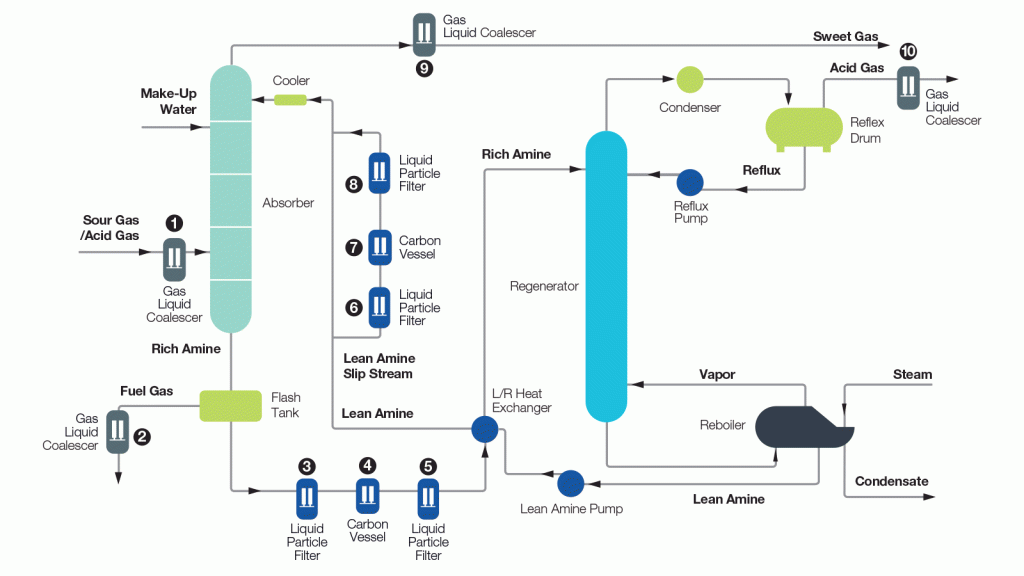
Amine Sweetening Unit typically consists of the following equipment:
- Inlet filter-separator (Optional)
- Amine Contactor Column
- Gas After Scrubber/Gas Coalescer
- Wash Water Column (Optional)
- Wash Water Pump (Optional)
- Flash drum
- Particulate/carbon filters
- Heat recovery exchangers
- Air cooled Heat Exchangers
- Hot oil/gas fired reboilers
- Stripper Column
- Reflux KO Drum
- Reflux Recycle Pumps
- Amine Booster Pumps
- Amine Transfer Pumps
- Chemical injection package (Optional)
- Fuel Gas Package for Reboiler (Optional)
- Control System (Optional)
- Amine Storage Tank (Optional)
- Offsite Utility
2. Membrane Method
Membrane based acid gas removal is a low cost method for low gas flowrates. Natural gas, with acid gases, is pre-heated and sent to the membrane unit.
The acid gas, H2S and CO2, selectively moves into the permeate phase and while HC gas moves around the membrane and is collected in the export gas stream. H2S removal up to 10 ppm and CO2 removal up to 2~4% is achievable using this process.
Equipment includes:
- Inlet Filter Separator
- Process Gas Heater
- Membrane Separator
- Gas Analyzer
3. Absorption Bed Media Method
This method utilizes selective adsorption of H2S and CO2 in a reactant media by moving the gas downflow in the reactor vessel. The H2S and CO2 gas reacts with the bed media to form a chemically stable byproduct.
This process can be offered in a 1+1 vessel configuration for maximum efficiency and extraction of acid gases. This finds application in low flow and pressure gas such as wellhead gas.
Equipment includes:
- Inlet Filter Separator
- Gas Analyzer
- Media bed Vessel
Additional Services:
- Custom built or Pre-Engineered Solutions
- Fast Track Delivery
- Concept Selection and FEED Studies
- Modular Solution for Offshore and FPSO
- Rental Option also available
- Debottlenecking and Retrofitting of Existing Plant for capacity Enhancement
- Site Support including Installation and Commissioning Supervision
Product Benefits:
- Proven and Reliable Design
- High efficiency Peerless Internals ensures minimal System downtime
- STAACO Black Powder Filter Separator can be offered at inlet
- Optimized design to optimized project schedule and delivery time
- Low cost of operation and maintenance
- Compliance to stringent HSEQ requirement
- Modular Solution requires minimum site works